
CUTIE STREET has now released more than one Korean version of its songs. I disliked the first one, but at the time I could still treat it as a one-off gesture. Groups sometimes make an unusual version for a specific audience, event, or promotional moment. I did not think one Korean recording by itself was enough to prove that CUTIE STREET was changing direction, even if I thought the idea behind it was bad.
The second release makes that harder to dismiss. Once the same group records multiple localized versions for the same market, the first one no longer looks like a novelty. It begins to look like a method. Korean fans are not simply being given subtitles, translated lyrics, or better access to the Japanese songs. The songs themselves are being rewritten for that audience.
The most common defense is that the Japanese originals still exist, so nothing has been lost. Korean fans get an additional version, Japanese fans keep the original, and everyone can choose what they prefer. I understand why this sounds harmless. It treats the localized recording as another file placed beside the first one, without changing anything else.
That is not how an idol song works. A translated recording is not only another object in a catalogue. It becomes another performance the idols themselves have to learn, remember, rehearse, promote, and potentially perform live. The cost does not remain outside the work as a line in a production budget. It enters the song itself, because the version performed for a particular audience may no longer be the version that made that audience a fan.
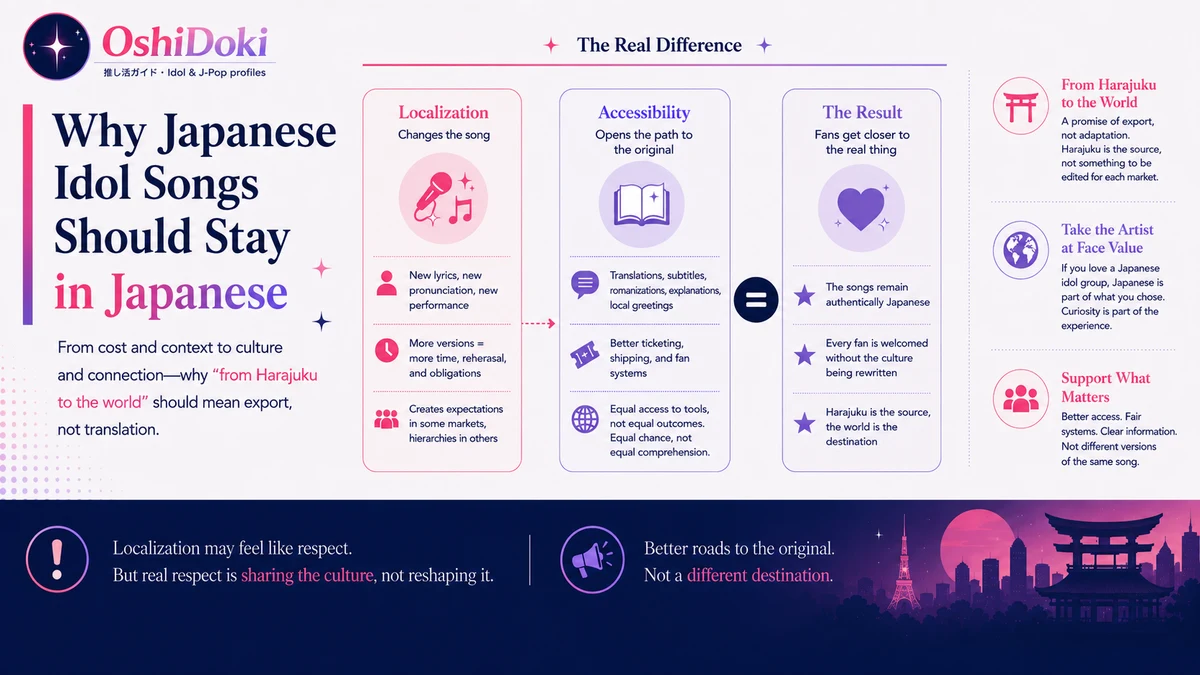
I object to translated recordings in principle. A Japanese idol group should not have to stop singing in Japanese in order to be welcomed abroad. Japanese is not packaging around CUTIE STREET that can be replaced while leaving the important part untouched. It is part of the sound, rhythm, identity, and culture of the group. If somebody can enjoy CUTIE STREET only after that part has been changed into something more familiar, then I am not sure CUTIE STREET itself is what that person wanted.
“From Harajuku to the world” should mean bringing something from Harajuku to the world. It should not mean remaking it in the language of every market before that market agrees to receive it.
“The Original Still Exists” Does Not Mean Nothing Changes
The fact that the original remains available only answers one very narrow question. It proves that the Japanese recording has not been deleted. It does not prove that the translated version costs nothing, changes nothing, or remains separate from the group’s continuing activity.
A listener can keep both versions in the same playlist and experience the Korean recording as an optional extra. The members do not have that same distance from it. They have to make it, carry it, and be prepared to perform it.
A Translated Recording Is Another Performance
A Korean version is not created by replacing a block of text and exporting a second file. The members have to learn unfamiliar pronunciation, rebuild the phrasing around different sounds, adjust where they breathe, remember a second set of lyrics, record the vocals, film promotional material, rehearse the new version, and reproduce it when the Korean version is expected at a concert or television appearance.
The fact that the melody and choreography already exist does not make the new version effortless. The idols still have to train their mouths around a language they do not normally perform in and make the result sound natural enough to carry the song. They also have to keep the Japanese and Korean versions separate in memory, especially when the same melody now leads to different words depending on the market.
This matters because idols are not static works. A translated manga volume can be produced by translators and editors while the original author continues working in Japanese. The translated volume sits beside the original without requiring the author to redraw and personally reperform every page for each market. An idol song remains attached to the people on stage. Every official version can become another version those same people are expected to embody.
The recordings may exist as separate files, but the performers do not exist as separate copies of themselves.
The Tradeoff Appears Inside the Song
Every group has limited time, and every new activity uses some of it. That alone is not an argument against localization. A music video takes time. An interview takes time. A new costume, concert arrangement, or variety appearance takes time. Groups constantly make decisions about what deserves attention.
The difference is that this particular tradeoff changes the work itself.
A second music video may give the song another visual interpretation, but the song remains the song. An interview may reduce rehearsal time, but the audience does not hear a different set of lyrics because the interview happened. A translated recording uses the members’ time to create and maintain a parallel form of the existing performance, one that may later replace the Japanese original in a particular market.
That is why the redirection is not neutral. The cost is not simply that an hour was spent on Korean pronunciation instead of something else. The cost becomes audible when the Korean version is selected for a live performance and the audience receives a different version of the song it originally came to hear.
If CUTIE STREET came to my country and performed an English version instead of the Japanese song, I would not experience that as a thoughtful gesture made for me. I would experience it as receiving a replacement for the thing I actually liked. The English version might be aimed at me geographically, but it would be further away from the reason I became a fan.
Nothing has been deleted, but the group’s attention and live identity still begin to divide across versions made for different markets. The original remains available while its position as the normal version of the song becomes less secure.
An Alternate Version Creates an Ongoing Expectation
The work does not end when the recording is released. Once a Korean version exists officially, Korean fans may reasonably expect to hear it live. Promoters may request it because it is the version made for that market. Television programmes may prefer it. Concert planning now has to decide which version the audience should receive.
A single translated song can remain a special performance. Multiple translated songs begin to establish a repertoire.
That changes the relationship between the group and the audience. The group is no longer simply travelling with one body of Japanese songs. It begins carrying domestic versions and market-specific versions, with the members expected to move between them depending on where they are standing.
Pointing out that the Japanese original is still on streaming services does not answer this. Availability is not the same as continuity. A song can remain available while becoming less likely to be the version presented abroad.
Accessibility Does Not Require Rewriting the Song
The argument for localized recordings is usually framed as accessibility. Korean fans may not speak Japanese, so a Korean version allows them to understand the lyrics and sing along more easily.
That treats accessibility and localization as though they were the same thing. They are not.
Accessibility helps people reach and understand the original work. Localization changes the work so that it feels more familiar to the target audience. Those two things can overlap, but they should not be confused.
A Japanese group can publish official lyric translations, subtitles, romanized lyrics, explanatory videos, multilingual websites, translated event rules, and clearer overseas ticket information. It can improve international shipping, allow foreign fan-club registration, and use interpreters for longer MC sections. It can greet an audience in the local language and explain what a song is about before performing it in Japanese.
None of this requires changing the song.
The fact that a Japanese song is in Japanese is not the same kind of barrier as a ticketing website that rejects foreign cards or a store that refuses to ship overseas. One is part of the work. The others are failures in the systems surrounding it.
Give Fans Better Access to the Original
International fans need much better access to Japanese idols than they currently receive. A Korean fan should be able to read a reliable translation of the lyrics. An English-speaking fan should be able to watch subtitled interviews and music videos. A European fan should be able to buy a CD without sending it through several expensive proxy services. An overseas concertgoer should be able to purchase a legitimate ticket without pretending to have a Japanese address and phone number.
Those are genuine accessibility problems, and companies should solve them.
The solution is to build a better road toward the Japanese song, not to replace the song at the end of that road.
Translated lyrics can explain the meaning. Romanization can help fans sing along. Subtitles can make the music video and interviews understandable. A local-language introduction can make an overseas audience feel acknowledged. All of these things bring people closer to the original rather than suggesting that the original language itself is an obstacle that needs to be removed.
Making a group accessible is good. Changing the group’s artistic output until it feels local is a separate decision, and it should not be treated as the only serious form of international outreach.
Equal Access Does Not Mean Equal Comprehension
Keeping one official Japanese version does not mean every listener will understand it with equal ease. A native Japanese speaker and someone who does not speak Japanese will never begin from the same linguistic position. That difference already exists, and no release strategy can make it disappear completely.
Equality does not mean that every person receives the same result without effort. It means that people have the same standing in relation to the work and access to the tools needed to approach it.
Everyone can receive the same official song. Everyone can be given translations, subtitles, romanization, dictionaries, and free translation tools. Some listeners will still understand more quickly than others, because language is inherently unequal between native and non-native speakers. That does not make the song inaccessible.
The group is not responsible for manufacturing identical comprehension by rerecording its output around each audience. Doing that would not remove inequality. It would add another form of it, because some markets would receive a version designed specifically around their language while others would not.
Keeping the songs in Japanese does not pretend that native and foreign listeners have the same experience. It simply avoids building a second market-by-market hierarchy into the official repertoire.
One Market’s Special Version Becomes Every Market’s Expectation
The first Korean version could still be described as a special gesture. Once there are multiple versions, the gesture starts to define what respect for an overseas audience is supposed to look like.
That creates a problem the group cannot solve.
If recording in Korean is presented as a meaningful way to welcome Korean fans, why should English-speaking fans not expect English versions? Why not Spanish, Portuguese, French, German, Ukrainian, Chinese, Indonesian, Thai, or any of the other languages spoken by audiences CUTIE STREET may eventually want to reach?
The group cannot maintain versions in every language. The translation work, pronunciation coaching, recording time, filming, rehearsals, and live preparation would become unreasonable long before every audience had received the same treatment.
The expectation can still form even though it can never be fulfilled.
Localization Turns Recognition Into a Ranking
Korean fans are understandably happy that CUTIE STREET made a version in their language. It feels like a sign that the group sees them and values their support. The problem begins when localization itself becomes evidence of how much a market matters.
Once one audience receives official recordings built around its language, other audiences can compare their treatment against that gesture. Fans may conclude that their country is too small, their support too weak, or their language too commercially unimportant to receive the same recognition.
The company then has to decide which audiences matter enough for the songs themselves to change. That decision will usually follow market size, promotional strategy, and commercial opportunity, which means the result is not broad cultural inclusion. It is a ranking of which markets are valuable enough to justify adaptation.
Keeping one Japanese version does not remove the existing difference between people who speak Japanese and people who do not. It does avoid creating a new difference between foreign audiences that receive bespoke official versions and those that are expected to accept less.
Every international audience receiving the same artistic object is not the same as every audience understanding it equally. It means no one market is granted the power to reshape the work around itself.
An Unrealistic Promise Still Creates Real Disappointment
This is sometimes dismissed as a slippery-slope argument, but the concern does not depend on CUTIE STREET eventually recording every song in ten languages.
A precedent can affect expectations even when management has no intention of following it all the way.
Fans only need to see that localized versions are available for one market before they begin asking whether their own market will receive the same. If the answer is no, the disappointment still exists. If the answer is yes for a few more markets, the comparison only spreads.
The danger is not that the group will successfully translate everything. The danger is that it establishes localization as the correct way to recognize overseas support while being structurally unable to recognize everyone that way.
A strategy can be impossible and still teach people what they are supposed to expect.
Language Is Part of the Song
The phrase “they only changed the language” makes language sound like a detachable layer placed over an otherwise complete musical object.
A song does not work like that.
Lyrics determine syllable count, vowel length, consonant placement, rhyme, emphasis, breath, and where the emotional weight falls inside the melody. A composition written around Japanese words has already been shaped around the sounds and structures of Japanese.
Replacing those words does not simply reveal the same song to a different audience. It rebuilds the song inside the limitations of another language.
A Singable Translation Is an Adaptation
A written translation can concentrate on meaning. A singable translation has to balance meaning against melody, rhythm, pronunciation, syllable count, memorable hooks, and natural phrasing.
Those demands often conflict. A line may need to be shortened because the translated sentence is too long. An image may be replaced because the direct equivalent does not fit. Word order changes. A vowel lands on a note written for a different sound. The translation may preserve the meaning but lose the rhythm, or preserve the rhythm by changing the meaning.
That does not mean translated songwriting is easy or worthless. A good singable translation requires real skill. The result may even work well as an adaptation.
My objection is to treating that adaptation as though it changes nothing.
Japanese and Korean may sometimes fit one another more easily than languages with very different sentence structures, but the consonants, vowels, and phrasing still change the texture of the performance. The Korean recording is not the Japanese song made transparent. It is a Korean adaptation of a Japanese song.
The difference would become even more obvious with English, German, French, or other languages whose sentence length, stress, and consonant structure fit Japanese melodies less naturally. A short Japanese phrase may require a much longer English sentence. A melody built around open vowels may become crowded with consonants. Something has to give.
Changing the language changes the sound, the delivery, and the relationship between the words and the melody. Language was already part of the song before anyone translated it.
The Song Is Not Incomplete Because You Need a Translation
A listener does not need to understand every word immediately for a song to work.
Music communicates through melody, voice, rhythm, choreography, expression, costume, and atmosphere as well as literal meaning. Lyrics matter, but a language barrier does not turn everything else into meaningless sound.
International fans discovered CUTIE STREET through Japanese songs before the Korean versions existed. They became fans without first receiving localized recordings. If immediate comprehension were necessary, they would not have arrived in the first place.
People learn choruses phonetically. They look up translations, recognize repeated words, memorize chants, and gradually understand more through exposure. This is not a failure in the fandom experience. It is part of listening to music from somewhere else.
A translation can deepen the connection without replacing the form that created it.
Take the Artist at Face Value
There is something backwards about becoming a fan of a Japanese idol group and then treating Japanese songs as a problem the group should solve.
The language was present when the fan arrived. It was part of the songs that created the interest in the first place. Nobody discovered CUTIE STREET through a culturally neutral product and only later found out that Japanese had been added as an inconvenience.
Fans should take artists at face value. If someone chooses to follow a Japanese group, Japanese songs are part of what that choice means.
The listener can read translations, memorize the chorus by sound, learn individual phrases, or enjoy the music before understanding every line. That is normal. It is how people have listened to foreign music for a very long time.
Foreignness Is Not an Accessibility Failure
Growing up in Europe, I never found it remarkable that music might arrive in a language I did not speak. English was common, but it was not the only language heard through television, radio, festivals, or other people. An unfamiliar language did not make the song unfinished until someone produced a Dutch, German, French, or English version for me.
There is an especially strong expectation in some English-speaking spaces that international success eventually requires everything to become linguistically familiar. Anything that remains in another language is treated as a barrier to growth rather than part of the work.
Most of the world already consumes music, films, books, and television in languages it does not speak fluently. People use subtitles and translations where necessary without assuming the original artist owes them a replacement.
International fandom should involve some curiosity from the fan. That is not gatekeeping. It is the smallest reciprocal part of cultural exchange.
The artist presents something made in a particular language and cultural setting. The audience approaches it. The entire burden should not move in the opposite direction until the artist has removed every unfamiliar element.
Do Not Enter a Fandom Expecting It to Rebuild Itself Around You
I explicitly support making Japanese idols easier to access abroad. I do not support the idea that accessibility means reshaping the artistic output around every audience that arrives.
A fan joins an existing relationship between an artist, a culture, and the work. Joining that relationship should not create an expectation that the artist will gradually move closer to the fan’s language and cultural preferences.
If somebody dislikes Japanese songs and needs an official localized version before the music becomes enjoyable, then a Japanese idol group may simply not be what that person is looking for. There is nothing wrong with that conclusion. Not every artist has to be made suitable for every possible listener.
The world contains enough music that people can choose what speaks to them without demanding that culturally specific artists become less specific.
If someone can enjoy CUTIE STREET only after the Japanese language has been removed, it is worth asking whether CUTIE STREET itself is what they wanted, or whether they wanted something more familiar carrying the same name and image.
“From Harajuku to the World” Is a Promise of Export
The phrase “from Harajuku to the world” has a direction built into it. Something from a particular place is being sent outward.
The value of the slogan lies in the fact that Harajuku comes first.
The World Is the Destination, Not the Editor
“From Harajuku to the world” is not the same promise as “Harajuku remade for the world.” The slogan does not say that every market will receive a version adjusted to its language and preferences. It says that something originating in Harajuku will travel beyond Japan.
Harajuku is not a decorative brand word attached to a generic international product. It names a place, an aesthetic, a cultural context, and a history. Japanese is part of that context.
The thing being exported has value because it came from somewhere specific. If every unfamiliar element is treated as a barrier to be removed, the source gradually matters less than the preferences of the receiving market.
At that point, the world is no longer simply receiving Harajuku. It is beginning to negotiate what Harajuku must become before it will accept it.
That is not what I want from cultural exchange. The unfamiliarity is part of the reason there was something worth discovering in the first place.
A Culture Does Not Have to Reflect Every Audience Back at Itself
One translated song does not destroy a culture, and two Korean versions do not suddenly make CUTIE STREET non-Japanese. That is not the argument.
The concern is what becomes normal once localization is accepted as the model for globalization.
A subculture becomes internationally interesting because it developed somewhere specific without first being optimized for every possible audience. Its particularity is not an inconvenience left behind by poor marketing. It is the reason people noticed it.
If maximum reach becomes the main rule, the elements least familiar to the largest markets will always come under pressure. Language is one of the first and most visible. Once it is treated as interchangeable, the group begins presenting itself less as a Japanese artist travelling outward and more as a product that can be reformatted for each market.
The thing that made Harajuku worth exporting was that it was not built for everyone in the first place. The world should not inherently change the Harajuku part.
Globalization Should Improve Access, Not Replace the Work
There is a great deal CUTIE STREET and KAWAII LAB. could do for international fans without recording the same songs in more languages.
Overseas fans need better merchandise shipping, clearer ticketing, multilingual event information, official lyric translations, subtitled media, and fan systems that recognize international participation. They need ways to support the group without being blocked by Japanese-only payment systems, phone-number requirements, or domestic addresses.
Those improvements would make globalization real because they would allow more people to reach, understand, purchase, and experience the Japanese work.
A translated recording does something different. Instead of removing the barriers around the work, it changes the work.
The better approach is to make the Japanese song easier to find and understand without treating Japanese itself as a defect. A Korean fan should be able to understand the Japanese song. That does not require CUTIE STREET to stop singing it in Japanese.
Keep Japanese Idol Songs in Japanese
I do not think one Korean version was enough to cause serious harm, even though I personally detested it. One recording could have remained a strange special gesture with little effect on the group’s wider identity.
The second version makes the direction harder to ignore. CUTIE STREET is now establishing localized recordings as part of its relationship with the Korean market. That creates expectations for other audiences, new obligations for the members, and a repertoire that can begin dividing according to where the group performs.
The group cannot translate its way through every language spoken by every fan. Attempting to follow that logic would create disappointment and a hierarchy of markets. Stopping after a few favored markets would create the same hierarchy more openly.
The deeper problem is that the strategy asks the wrong side of the cultural exchange to move. It teaches international fans that welcoming them means making the Japanese group sound less Japanese, when the Japanese language was part of what the group was supposed to carry outward.
“From Harajuku to the world” should ask the world to approach Harajuku with curiosity. It should not ask Harajuku to return in whichever language makes each market most comfortable. Translations should sit beside the song, subtitles should sit beneath the video, and the stores, ticket systems, and fan communities should be opened to the world. The songs themselves should remain Japanese.