
Introduction
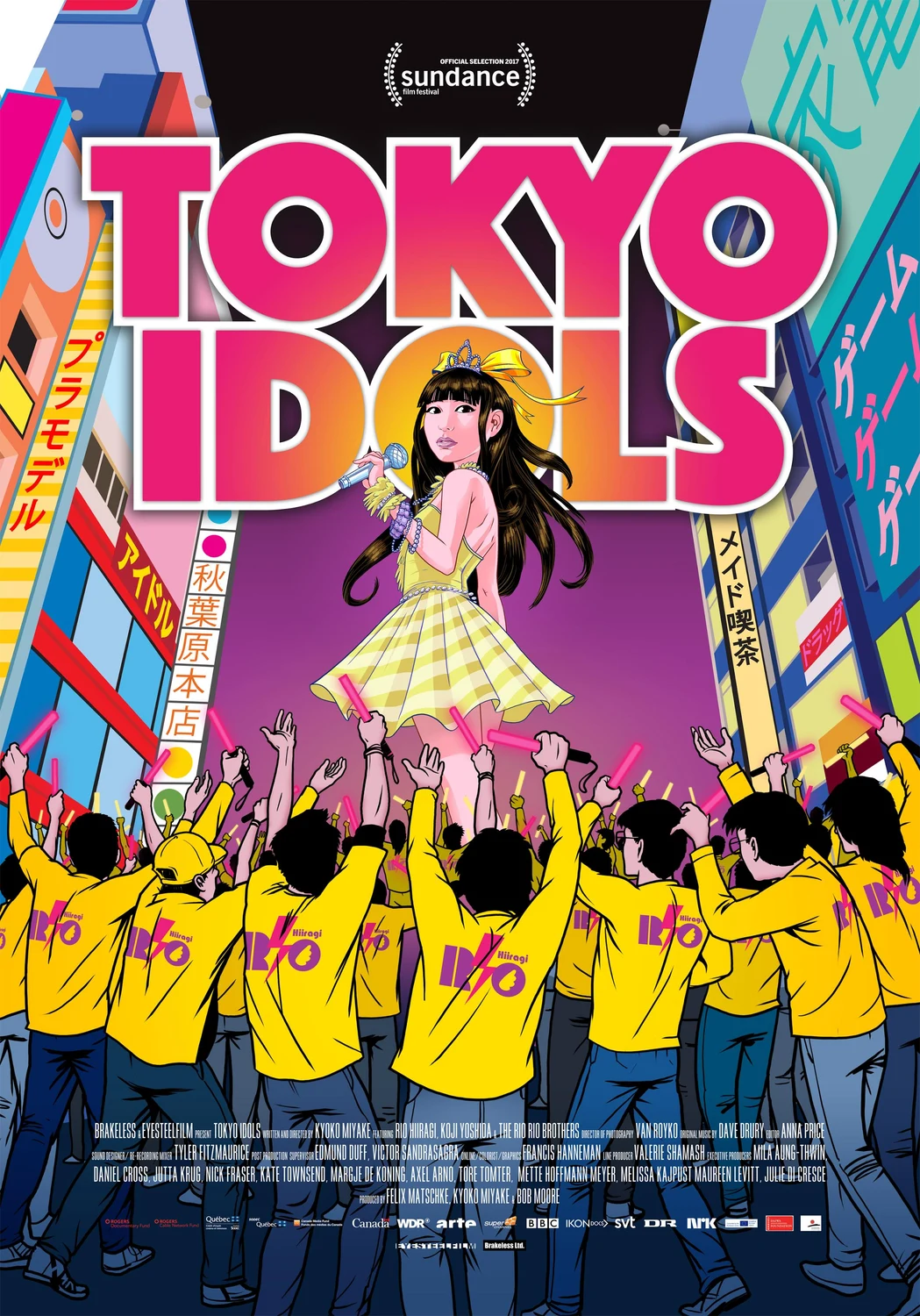
After someone on Instagram insisted that idol fans are creeps and that the idols themselves are victims who do not truly want this life, they implored me to watch Tokyo Idols to “educate” myself on idol culture.
What I found instead was a documentary that seems less interested in understanding idol culture than in confirming its own assumptions about it. Through dramatic music cues, selective editing, questionable translations, and a constant push toward a particular ideological interpretation, the film frames idols primarily as victims and their fans as emotionally stunted men searching for substitutes for real relationships.
Framing and Manufactured Unease
From the very beginning, the documentary sets an ominous tone. Ordinary backstage interactions and handshake events are presented with dramatic music and uncomfortable framing, as if the audience is supposed to immediately sense that something disturbing is happening.
Yet much of what is actually shown on screen is fairly mundane by entertainment industry standards: fans attending live performances, briefly meeting performers, buying merchandise, and supporting artists they admire. A handshake event is treated as inherently strange or intimate, despite similar fan interactions existing throughout entertainment culture worldwide. The documentary rarely allows viewers to interpret these scenes on their own. Instead, it constantly pushes the audience toward suspicion.
The “Experts” and the Illusion of Authority
Another major issue with the documentary is its reliance on “experts” whose primary role seems less about informing the audience and more about telling viewers what they are supposed to think about what they are seeing.
Rather than allowing scenes to speak for themselves, the documentary constantly cuts away to commentators who reinterpret ordinary fan behavior through the lens of sexuality, patriarchy, or emotional dysfunction. These expert segments rarely add meaningful insight or nuance; instead, they function as framing devices that push the audience toward a predetermined conclusion.
A good example is Masayoshi Sakai, introduced as an economic and industrial analyst, who claims that handshake events carry a sexual nature or exist in a legal grey zone. But why is an economic analyst being treated as an authority on the psychology or sociology of fan interaction? The documentary never challenges his assumptions or explains why his opinion should carry weight in this context. His role is not to investigate the phenomenon, but to establish an early narrative: that idol fans are primarily motivated by sexual gratification.
Minori Kitahara and the Question of Agency
The same pattern appears with feminist commentator Minori Kitahara, whose commentary consistently interprets idol culture through the lens of male domination and female victimhood. At one point she claims that male fans "never try to hold hands with regular women" and expect to be loved without effort. This is a sweeping psychological generalisation about men she does not know, presented as established fact rather than interpretation. The irony is hard to miss: the documentary criticises these men for lacking empathy or self-awareness, while simultaneously showing very little interest in understanding them as individuals. At another point she states:
"Instead of connecting with women in their everyday life, the men choose girls they can dominate, girls who are guaranteed not to challenge or hurt them"
The word "dominate" is doing a great deal of interpretive work here, especially for a claim presented without supporting evidence. Once again, speculation about motive is treated as established fact.
Her commentary on women fares no better. At several points Kitahara seems unable to accept that idols might genuinely enjoy performing, dressing up, singing, or cultivating a fanbase. When she says "you are conditioned to want this," the framework she's applying leaves almost no room for female agency. Any woman who expresses genuine enjoyment of idol work can simply be dismissed as not knowing her own mind. In trying to critique patriarchy, the argument ends up stripping the women involved of exactly the autonomy it claims to defend. Like Sakai before her, Kitahara is not here to examine idol culture. She is here to confirm what the documentary has already decided about it.
Translation Choices and Loaded Interpretations
The documentary’s translations also occasionally feel loaded in ways that push viewers toward a more uncomfortable interpretation than the original Japanese necessarily implies. Phrases like “いいなと思った子,” which more naturally means “a girl I thought was nice” (or casually, “a girl I liked”), are translated as “having a crush,” while words like “少女” are rendered as “little girl” instead of the broader “young woman” or “young lady.” Another example appears near the end, when a fan describes young idols as not yet “completed” using the word “完成,” clearly referring to artistic growth and development, but the translation “developed” leaves room for a far more sinister interpretation in English.
Even the translation of words like kawaii loses cultural nuance. In Japanese, kawaii is an extremely broad and generally innocent expression used for many things, not purely romantic or sexual attraction. Yet the documentary repeatedly frames these interactions through a narrow lens.
This issue is not limited to word choice in subtitles, but extends to broader contextual framing as well. When cultural context is missing, even neutral statements can appear far more extreme than intended.
A clear example is how fans expressing concern about an idol 'turning 17' are presented without clarifying that, within the AKB48 idol industry culture, this age often represents a transitional point where performers consider whether to continue professionally or pursue other paths such as education. Without that context, the comments can appear far more sinister than they were likely intended.
This does not necessarily require assuming malicious intent in editing, but it does highlight how omission of context can subtly steer interpretation. When combined with selective translation choices, it contributes to a viewing experience where the audience is often guided toward a particular reading rather than being equipped to understand the cultural setting on its own terms. This pattern appears throughout the film: Ordinary or ambiguous statements are subtly reframed, one mistranslation at a time, to build a case the footage alone could never support.
The Question of Younger Idols
To be fair, the sections involving very young idols are probably the part of the documentary that will make many viewers uncomfortable, especially outside Japan. Seeing adult fans support child performers can understandably appear strange or off-putting at first glance, and that discomfort is not inherently unreasonable.
However, even here, the documentary often seems more interested in implying danger than investigating the actual relationships being shown. Several parents initially shared the same suspicions and concerns that outside viewers might have, yet after becoming involved in the community themselves, they no longer viewed the fans as threatening or predatory. Amu’s mother, for example, openly states that the fans are kind and supportive.
The documentary rarely explores this contradiction in depth. Instead of asking why parents and performers themselves often feel safe and supported within these communities, it largely treats their perspectives as secondary to the interpretations of outside commentators.
That does not mean every aspect of idol culture is beyond criticism, nor that exploitation can never occur. But the refusal to seriously engage with the more ordinary, positive, or community-driven side of these interactions weakens its credibility.
The Human Stories the Film Accidentally Captures
What makes this especially frustrating is that the documentary accidentally captures something far more human and sympathetic than its own thesis. Rio’s story is ultimately uplifting: a young woman building a career, developing confidence, and cultivating a loyal community around her performances. The same applies to fans like Koji, whose involvement in idol culture appears to motivate him to improve his life, pursue ambition, and connect with others socially.
The documentary repeatedly tries to frame idols as replacements for relationships, but it largely fails to prove this. Most of the fans interviewed seem to have already been lonely or struggling before discovering idol culture. For many of them, idols are not substitutes for life, but catalysts that help them engage with it more positively. Others simply enjoy the music, performances, and sense of community surrounding the scene.
Of course, there are legitimate criticisms that can be made of idol culture. Like any fandom or subculture, there are people who take it to unhealthy extremes, and the documentary does occasionally touch on individuals whose attachment clearly consumes too much of their lives. Those cases exist, and ignoring them entirely would be dishonest. But the film consistently presents those extremes as representative of idol fandom as a whole, which is deeply misleading.
The documentary also creates a contradiction in its own moral framing. On one hand, it suggests these men should pursue “normal” relationships instead of idol culture. On the other hand, it portrays them as socially deviant, emotionally deficient, or implicitly unworthy of such relationships. It criticises their isolation while contributing to the stigma that reinforces it. What it overlooks is that for most people, idol fandom is not an escape from life but a way of participating in it: a hobby, a community, and sometimes even a source of motivation for personal growth.
Many idol fans are ordinary, well-adjusted people who enjoy live performances, music, community, and supporting performers they genuinely want to see succeed. Reducing an entire subculture to its most extreme or awkward examples is no different from judging any hobby solely by its worst cases.
Where Are They Now?
It is also worth noting that many of the idols featured in the documentary continued pursuing entertainment careers long after filming ended.
Amu remains active as an idol with idol group Nonfic, Rio continues performing live and is a VTuber, and Yuzu went on to become a singer, dancer, actress, and model under LDH as part of the group Girls². Their continued careers do not prove that every part of the industry is harmless, but they do complicate the documentary’s implication that idol culture is primarily a dead end or inherently a site of victimhood.
That reality does not fit neatly into the documentary’s framing, but it is an important piece of context nonetheless.
Conclusion
In the end, Tokyo Idols feels less like an honest exploration of idol culture and more like a work guided by a predetermined interpretive framework.
Ironically, the most compelling parts of the film are the moments that resist its own reading. Beneath all the ominous music, selective editing, and moral framing is a far more ordinary and human story: performers chasing dreams, fans finding community, and people supporting something that brings meaning and enjoyment into their lives.
The issue is not that the film asks critical questions about idol culture. It is that it repeatedly applies interpretive pressure that narrows what those answers are allowed to be. Scenes are rarely left open for the viewer; instead, they are steered toward a preferred reading through expert commentary, selective emphasis, and tonal cues.
Ultimately, that is the film’s central limitation: it spends so much time constructing a moral narrative that it loses sight of the lived reality it is attempting to document.