
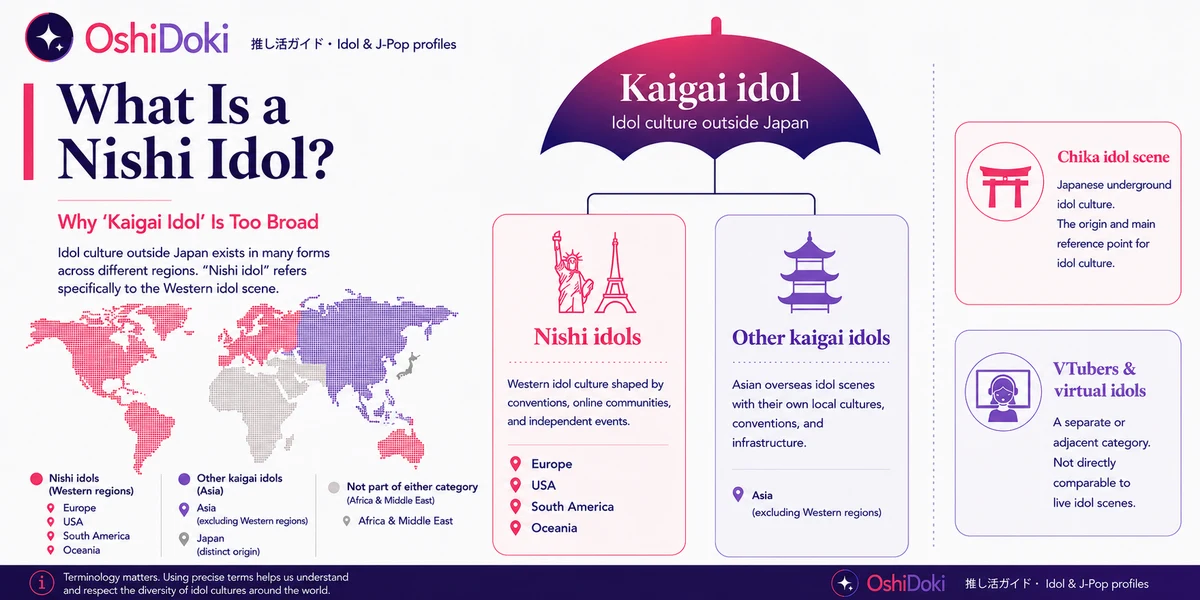
“Kaigai idol” literally means overseas idol, and in its broadest use it can refer to almost anyone doing Japanese-idol-inspired performance outside Japan. That simplicity is probably why the term became useful in the first place, but it is also why it has become increasingly misleading. It places performers with different levels of backing, different routes into entertainment, different cultural expectations, and completely different relationships with their audiences under one name, then treats that name as though it describes a coherent international scene.
I saw the problem clearly during a recent discussion about Western convention-based idols. In response to criticism of their performance standards, one defender listed Hololive English and Indonesia, overseas 48 groups, professionally produced Asian acts, and small independent performers as examples of what the kaigai idol scene supposedly contained.
The intention was to prove that good overseas idols exist. What it actually demonstrated was that the category had become too broad to mean anything useful.
Hololive Production officially describes itself as a VTuber agency, and COVER Corporation describes its business as producing VTubers, concerts, events, and related intellectual property. Individual Hololive talents may use idol imagery, sing, dance, and perform concerts, but they still belong to a corporate virtual-entertainment structure that is not meaningfully comparable to a self-produced person appearing at a local anime convention.
JKT48 is different again. Its official site includes organised schedules, an official fan club, and priority access to theatre performances, concerts, and other events. Whatever level of polish an individual performance may reach, this is clearly an established regional operation with recurring infrastructure around both the performers and the audience.
A corporate VTuber agency, an established Asian idol operation, and a self-produced Western convention performer may all exist outside Japan, but that is almost the only useful fact they share. Calling all of them one scene is like placing a professional racing team, a driving school, and someone rebuilding a car in a garage into one category because all three involve cars.
The problem is not that one of these is legitimate and the others are not. The problem is that the category tells us almost nothing about which one we are discussing.
One Label Is Being Used for Several Different Scenes
There was a time when a broad overseas label probably made sense. People outside Japan who were interested in becoming idols had few local structures, limited visibility, and no clear vocabulary for what they were doing. A shared name connected performers who might otherwise have remained isolated in dance-cover communities, convention scenes, online singing circles, and small local events.
As those scenes developed, however, they did not all develop in the same direction.
An Indonesian group with recurring shows, organised fan activities, and an established local audience is not simply a more successful version of an American convention idol. A Thai group, a Taiwanese independent act, a corporate English-language VTuber, and a European performer arranging everything alone may all draw from Japanese entertainment, but they do so through different systems and for different audiences.
The Thai and Taiwanese acts I have personally seen did not feel like Western convention performers with different passports. They had their own performance culture, and what stood out was not only technical ability. There was charm, warmth, decorum, and an understanding that the audience experience mattered. Even where the production was not enormous, the performers gave the impression that being an idol involved more than adopting the visual identity and asking to be recognised through it.
That does not mean every Asian overseas idol is good, or that every Western idol is bad. It means that “not Japanese” is not enough to make them one culture.
Outside Japan Is Not a Production Model
The existing label hides differences in management, training, frequency of performance, access to venues, audience expectations, and the amount of experience a performer can gain before appearing at a large event. It can refer to an organised regional industry in one conversation and an isolated hobby scene in the next.
Even the inclusion of Hololive shows how elastic the term has become. Hololive talents may participate in idol-like music and concert activities, but the organisation is primarily a VTuber agency. Whether someone considers virtual performers a type of idol is a separate discussion. They are still not useful evidence for the quality or potential of an independent Western live performer.
The same problem appears when established Asian groups are invoked. A group with management, a recurring schedule, and an existing local fan system may be overseas relative to Japan, but it is not participating in the same practical scene as a performer whose main opportunities come from conventions and social media.
“Kaigai” describes location. It does not describe a production model, performance standard, or community culture.
What the Broad Kaigai Idol Category Hides
The broadness of the term would be harmless if it were only used as a geographical umbrella. The problem begins when people treat everything beneath that umbrella as evidence for the quality, legitimacy, or behaviour of one shared scene.
The strongest examples can then be used to support the weakest, while the reputation created by the weakest or most combative part of the community spreads outward to everybody else using the label.
Western Performers Can Borrow Credibility Upward
When somebody criticises a self-produced Western performer, defenders can point to the strongest act located anywhere outside Japan. A professionally organised Asian group becomes evidence that American convention idols are being underestimated. A corporate VTuber concert becomes proof that kaigai idols can produce polished live entertainment. An established 48-group operation becomes part of the same defence as somebody who performs a few times a year and arranges everything alone.
None of these examples answers the criticism being made. They demonstrate that strong entertainment exists outside Japan, which nobody needed convincing of in the first place. They do not show that the specific Western scene under discussion has reached the same standard.
This allows Western performers to receive the reputational benefit of organisations that do not share their management, training, funding, audience, or opportunities. The accomplishments of unrelated Asian performers are treated as collective kaigai achievements whenever that association is useful.
The category can then contract again when somebody asks why a Western performance was weak. At that point, the scene is no longer represented by established Asian groups or corporate productions. It becomes a vulnerable collection of unsupported beginners who are learning everything in public and should not be judged according to professional expectations.
The meaning changes according to what the argument requires. It expands when better performers are needed for credibility and shrinks when less experienced performers need protection.
Asian Overseas Idols Inherit Western Reputational Damage
The reputational exchange also moves in the other direction. The public behaviour of Western kaigai idol culture, particularly in US-centred online spaces, becomes attached to every overseas performer sharing the term.
In the communities I have followed, mild criticism is often turned into a question of morality and loyalty. A performance is described as weak, and the response becomes that the critic hates idols, should keep the opinion private, or cannot consider himself a supporter. Questions about pitch, timing, preparation, and stage presence are replaced by stories about how hard the performer worked and how vulnerable it is to stand onstage.
I discussed this more fully in my previous article, Why Western Kaigai Idols Aren’t Working, and I Don’t Think It’s Talent. The point was not that every Western performer behaves this way. It was that the community’s public relationship with criticism makes both improvement and audience sympathy harder than they need to be.
When all overseas idol activity shares one label, that behaviour becomes part of the image of kaigai idols generally. Thai, Taiwanese, Indonesian, Filipino, and other Asian performers are made to carry a reputation created by discussions in a largely Western online community.
I find that unfair to those performers. They have their own scenes, audiences, local expectations, and histories. They should not be associated automatically with Western convention culture merely because neither group is based in Japan.
The broad label lets Western performers borrow the standing of stronger Asian scenes while forcing those Asian scenes to inherit Western community baggage.
The Western Scene Has Become Its Own Idol Culture
The case for a separate term does not depend only on technical quality. The Western scene has developed its own routes into performance, its own audience environment, and its own recurring arguments about what makes somebody an idol.
In Europe and the Americas, Japanese-idol-inspired performers often emerge through anime conventions, dance-cover communities, social media, online collaborations, and small independent events. Even where performers take lessons or receive some management, the surrounding ecosystem is still shaped by Western fan culture and by the convention circuit rather than by an established Asian idol industry.
The Western scene has also developed a recognisable public attitude toward legitimacy. Its performers and fans regularly compare themselves with Japanese chika idols, ask to be treated as part of the same tradition, and resist suggestions that the average performance standard may be different. When an unfavourable comparison is made, however, the lack of Japanese infrastructure becomes the explanation for why the comparison should not have been made.
In the previous piece, I called this Schrödinger’s chika idol. The chika idol becomes a supported professional whenever her structural advantages are needed to excuse a weaker Western performance, then becomes an unsupported amateur whenever her struggles are needed to establish parity.
The broad kaigai idol category performs the same movement on a larger scale. It includes polished Asian acts when their quality is useful, then centres unsupported Western beginners when sympathy is useful.
This is not one global scene reacting differently in different locations. It is evidence that separate scenes already exist and that the vocabulary has failed to acknowledge them.
Why I Use the Term “Nishi Idol” (西アイドル)
I propose Nishi idol as a term for Japanese-idol-inspired performers whose scene developed primarily within the Western cultural sphere, especially Europe and the Americas, through conventions, online communities, local events, and independent production.
I am not presenting Nishi idol as an existing Japanese industry term. It is a term proposed and used by OshiDoki because the current vocabulary is no longer precise enough for the distinctions I need to make.
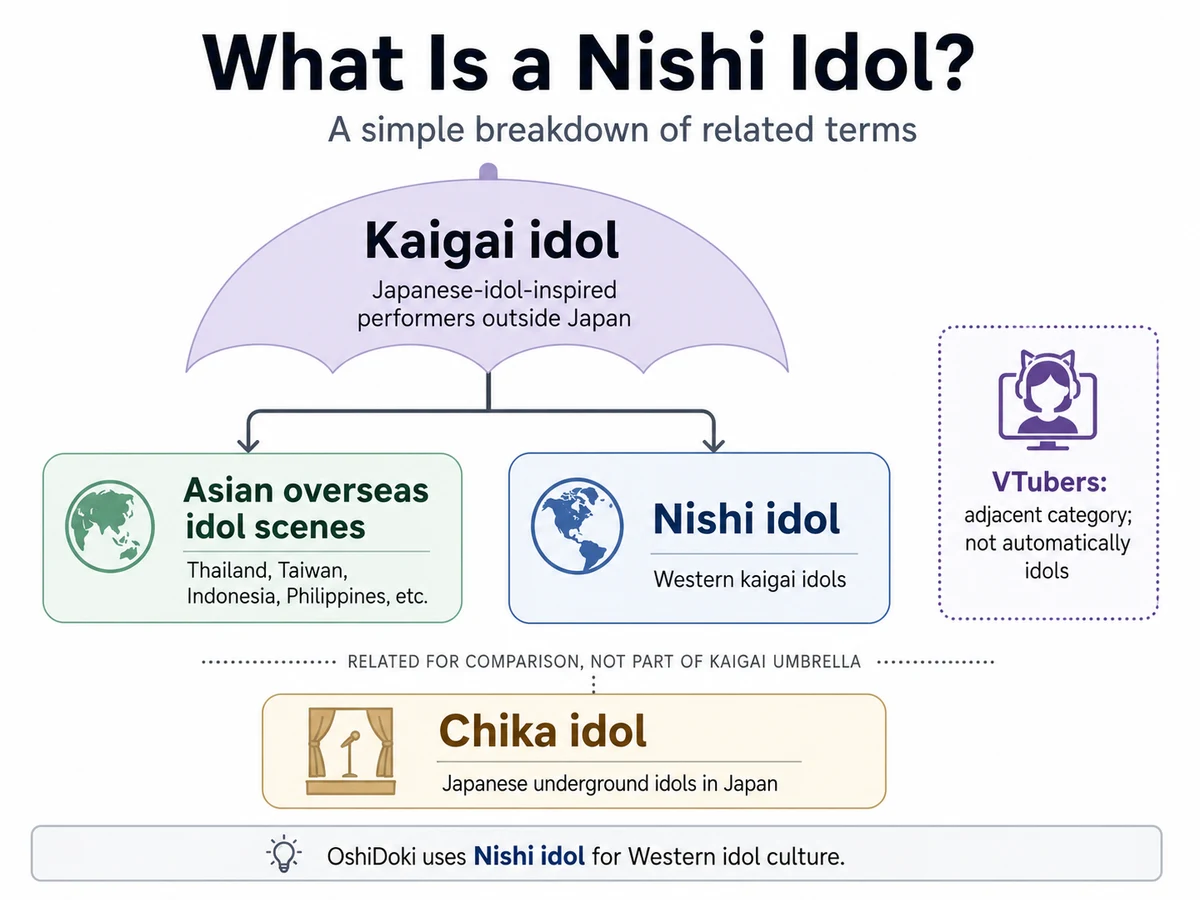
The category is cultural rather than based on literal longitude. South American performers would be included because their local scenes have generally developed through Spanish- and Portuguese-speaking convention and internet cultures rather than through established East or Southeast Asian idol industries. Similar scenes elsewhere could also be described as Nishi idol culture when their main influences, audiences, and routes into performance belong to the same broader Western ecosystem.
The boundary will not be perfect. No large cultural category is. It only needs to be more informative than placing everyone outside Japan into one scene.
Why Nishi Idol Instead of Seiyō (西洋) Idol
Seiyō idol is a possible alternative and may communicate “Western idol” more literally. I prefer Nishi idol because it is shorter, easier to remember, and sounds more natural beside established fan terms such as chika idol and kaigai idol.
A new term only has a chance of becoming useful if people can say it naturally. Nishi idol is simple enough to work in an article title, glossary entry, social media post, or ordinary discussion without requiring a long explanation every time.
The more formal linguistic option is not necessarily the better community label. The purpose is clarity and memorability rather than producing the most literal Japanese translation.
The Term Describes a Scene, Not an Ethnicity
Nishi idol refers to the ecosystem surrounding the performer, not her race or nationality. An ethnically Japanese artist working primarily through American convention culture could still be a Nishi idol, while a non-Japanese performer embedded in an established Thai or Taiwanese scene would not automatically belong to the category.
It also does not distinguish between professional and amateur performers. The current Western scene is not large or developed enough for that to be its primary division. A Nishi idol can be self-managed, represented by a small organisation, pursuing a career, or treating performance as a serious hobby.
Those distinctions may become more useful if the scene develops larger companies, recurring venues, and clearer professional tiers. At the moment, the shared cultural and performance ecosystem is the more useful starting point.
Why the Term Will Probably Be Resisted
I do not expect “Nishi idol” to be accepted without pushback. Some performers and fans will probably call the distinction unnecessary, gatekeeping, exclusionary, or even racist. That reaction is predictable when a community accustomed to a broad and flattering identity is told that the label conceals meaningful differences.
The distinction is not racial. Nishi idol refers to a performance ecosystem shaped by Western convention culture, online communities, and audience expectations, not the ethnicity of the performer. Nor does the term declare Western performers fake or illegitimate. It acknowledges that they operate in a different context from Japanese chika idols and many established Asian overseas scenes.
Some of the resistance may also be practical. The broad kaigai idol label gives Western performers useful flexibility. They can invoke polished Thai, Indonesian, or Taiwanese acts, as well as corporate productions, when they want evidence of overseas quality, then narrow the discussion to unsupported beginners when their own performances are criticised. It also allows criticism of Western convention culture to be presented as an attack on every idol outside Japan.
Nishi idol removes some of that flexibility. It keeps the discussion focused on the Western scene’s own conditions, results, and community behaviour. That loss of rhetorical protection is one reason the term may prove unpopular, and also one reason the distinction is necessary.
I am not asking the Western community for permission to use a more accurate label in my own writing. Whether performers adopt Nishi idol themselves is up to them. Rejecting the word does not erase the differences it describes.
Nishi Idol Should Carry the Western Scene’s Reputation
Nishi idol should not mean bad idol by definition. It should identify the Western ecosystem rather than assigning a quality score to everybody inside it. A performer who trains seriously, treats fans well, improves consistently, and creates an excellent live would still be a Nishi idol.
She would also, fairly or unfairly, be associated with Nishi idol culture and its existing reputation.
That may be frustrating for serious Western performers, but it is not unique to idol culture. People are judged partly through the communities, industries, and labels they publicly participate in. A strong performer cannot benefit from a shared scene when it provides audiences, collaborations, events, and legitimacy, then treat herself as completely separate when that scene develops a poor reputation.
The solution is not to keep every overseas performer beneath the same label so that the reputation becomes harder to locate. That only asks unrelated Asian performers to absorb part of the cost. The solution is for serious Nishi idols and serious fans to challenge the behaviour that created the reputation.
Serious Performers and Fans Share Responsibility
If the loudest people in the scene respond to criticism with hostility, better performers should not quietly allow them to define the culture. If fans organise pile-ons, turn negative opinions into accusations of hatred, and use chika idols selectively as argumentative tools, other fans should say that this is not how they want their community represented.
A serious performer may object that she did not personally participate in any of this. That may be true, but reputations are collective long before they become fair. The performers and fans with the most to lose from a bad reputation also have the strongest reason to challenge the behaviour producing it.
A separate term creates clearer ownership. The problems of Nishi idol culture become problems for Nishi idols and their supporters to address, rather than problems that can be dispersed across every performer outside Japan and dismissed as somebody else’s responsibility.
The same is true of its successes. If serious performers establish better standards, create welcoming events, improve their live ability, and treat audiences with respect, the reputation of Nishi idol culture can improve through their work.
That would be a more meaningful achievement than borrowing credibility from unrelated Asian performers whenever criticism appears.
What Nishi Idol Culture Can Learn From Its Japanese Roots
Western performers do not need to reproduce every part of the Japanese idol industry. Some parts of that industry are exploitative, restrictive, or financially damaging to the people inside it. Learning from the Japanese roots of idol culture does not require copying every management practice or pretending that Japan is perfect.
It does require understanding the attitude that makes an unfinished performer appealing.
In the chika scene I follow, an idol can be technically weak and still create a live that people enjoy because she offers warmth, personality, presence, gratitude, and a visible desire to improve. She does not need to insist that she has already reached the same level as somebody with more experience. The gap becomes part of the relationship with the audience, because people can see where she began and become invested in where she might go.
The public posture is generally directed towards the next lesson, rehearsal, and live. Weakness may not be announced openly, but it is not replaced by a demand that the audience call the current result good. Support is earned through the experience being created rather than guaranteed by the decision to call oneself an idol.
Nishi idol culture needs more of that orientation. It needs less energy spent defending the last performance and more spent preparing for the next one. It needs fans who protect performers from harassment without pretending that every negative assessment is harassment, and performers who understand that effort can be respected while the result is still judged honestly.
Most importantly, it needs to stop treating Japanese idols as a source of borrowed status. Chika idols should not be invoked only when their identity can be used to elevate a Western performer or excuse her weaknesses. If Nishi idols want to claim Japanese idol culture as an artistic root, they should show respect for the craft, the audience, and the process of improvement that made the culture appealing to them.
The aesthetic is easy to borrow. The discipline and public decorum are harder, but they are also the parts that give the aesthetic meaning.
What the Nishi Idol Distinction Would Accomplish
Separating Nishi idols from the broader kaigai label would protect Asian overseas scenes from being reduced to evidence in Western arguments. Thai, Taiwanese, Indonesian, Filipino, and other Asian idols could be discussed through their own histories, industries, and local standards rather than being treated as distant proof that an American convention performer deserves equal recognition.
It would also make criticism more precise. A complaint about US or European convention culture could remain focused on that culture rather than being inflated into an attack on every non-Japanese performer. Defenders could no longer answer criticism of one developing scene by listing the strongest act available anywhere outside Japan.
Most importantly, the distinction would make responsibility more precise. Nishi idol culture would belong to the performers and fans participating in it. Its successes would be theirs, but so would its failures. Serious members of the scene would have a stronger reason to challenge toxic behaviour because the reputation could no longer be diluted across a global category.
This would also create space for good Nishi idols to become recognised as good Nishi idols. They would not need to distance themselves from Western culture by borrowing the identity of chika idols or professionally organised Asian groups. Their work could raise the standard of their own scene.
An Asian idol can be bad, and a Nishi idol can be excellent. A corporate production can deliver a disappointing performance, while somebody working alone can produce something remarkable. The category is not a verdict on quality.
It is the context in which quality can finally be discussed honestly.
Kaigai Idol Can Remain a Broad Umbrella
There may still be situations in which kaigai idol is useful as a geographical umbrella. International festivals, directories, historical discussions, and collaborations may genuinely need a term for Japanese-idol-inspired performers outside Japan.
The mistake is treating that umbrella as though it were one coherent scene.
A broad term can contain smaller cultures without making them interchangeable. Nishi idol would name one of those cultures, while Thai, Taiwanese, Indonesian, Filipino, and other Asian scenes could continue using their own national, regional, or organisational identities.
The term does not need to replace kaigai idol completely. It needs to stop kaigai idol from pretending to be precise when it is not.
This distinction should also appear in the OshiDoki glossary. Kaigai idol can be defined as the broad overseas category, while Nishi idol is identified as the more specific term OshiDoki uses for Western idol culture. That relationship makes the new term easier for readers and search engines to understand without falsely presenting it as established vocabulary. The glossary itself already functions as a plain-English reference for Japanese idol and fan terminology.
The Negative Reputation Needs to Be Contained Before It Spreads Further
The Western scene has already created an image of itself through its most visible online behaviour. That image includes technical inconsistency, convention-based hobbyism, defensiveness towards basic criticism, constant comparison with chika idols, and a tendency to demand the emotional rewards of fandom before earning the audience’s trust.
There are serious performers inside that scene, and it is unfortunate that they are associated with those problems. But the answer cannot be to continue placing every idol outside Japan beneath the same label so that Western performers are less exposed. That only asks unrelated Asian performers to absorb part of the reputational cost. The reputation should remain attached to the culture that produced it, where the people participating in that culture have some ability and responsibility to change it.
Nishi idol gives that culture a name. It separates Western performers from Asian kaigai scenes, gives critics a more accurate term, and gives serious Nishi idols something concrete to improve. It also makes clear that the Western scene cannot continue borrowing credibility from the Japanese and Asian performers it alternately imitates, dismisses, and uses as a defence.
A different name will not fix the community by itself, but it will make the location of the problem harder to avoid. Better performers and serious fans will then have a choice. They can acknowledge that the reputation was built through repeated behaviour and begin holding their own community to a higher standard, or they can continue treating every criticism as an attack and demonstrate why the distinction was needed.
This will probably be the last I write about Nishi idols for some time. As the scene currently exists, it does not interest me, and its public culture has given me little reason to feel sympathetic towards it. That may change in the future, but it would require the scene itself to become something different from what I have encountered so far.
Kaigai idol can remain a broad geographical umbrella when that broadness is useful, but it should no longer be treated as the name of one coherent culture. Asian overseas idols deserve identities that are not burdened by the Western scene’s reputation, while Western performers deserve a category whose reputation they are responsible for building.
I propose calling that category Nishi idol culture. What the term comes to mean should depend on what its performers and fans choose to do with it.