
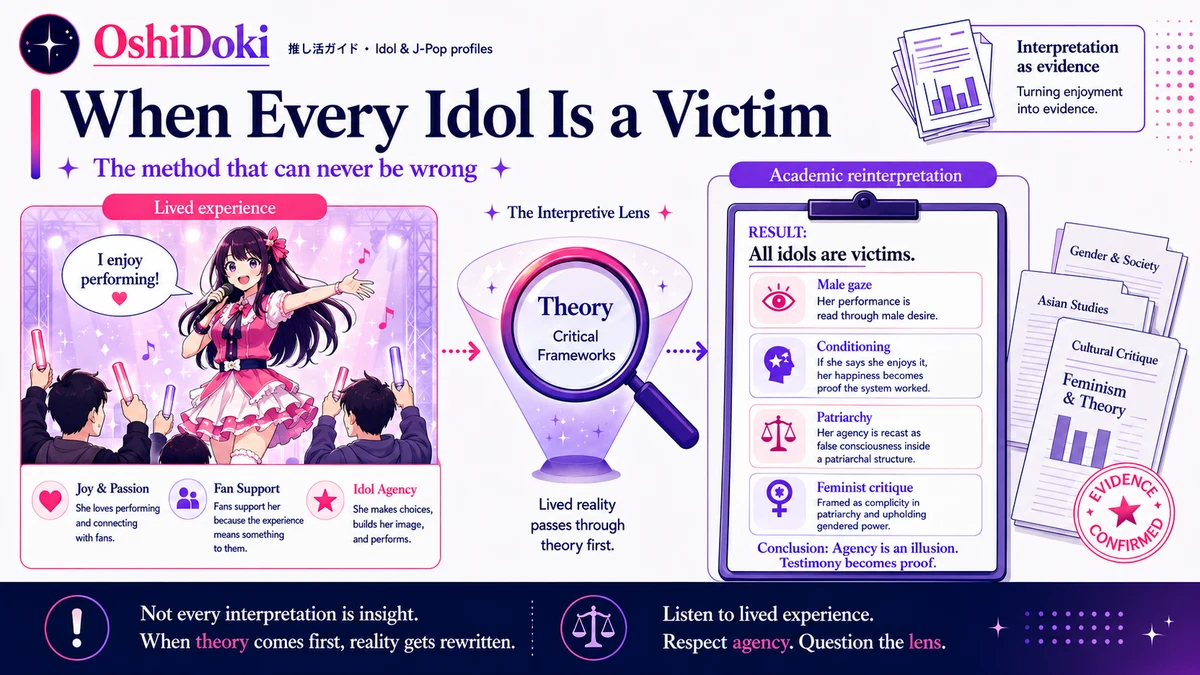
There is a specific move that shows up across a recurring strand of English-language academic writing on Japanese idol culture, and once you notice it, you cannot stop seeing it. An idol says she enjoys her job. A fan says he supports a group because it makes him happy. And the paper does not take either statement as evidence of anything. It takes the statement as the thing that needs to be explained away.
This is not a complaint about individual scholars being wrong about idols. It is a complaint about a method that cannot register "this is fine" as a possible conclusion, no matter what the people inside the scene actually say about their own lives.
The Move, In Its Purest Form
Yasheng She's 2023 paper in the Journal of Asian Pacific Communication, "A cure for woundless pain: Consumption of innocence in Japanese idol culture," is a clean example, mostly because it is honest about its own logic rather than burying it. (Journal of Asian Pacific Communication, John Benjamins; full text via academia.edu)
She builds on Laura Mulvey's "male gaze" by adding what she calls the "guardian gaze": the idea that male idol fans do not need to be overtly sexual to be participating in an objectifying, patriarchal structure. Supporting an idol financially, wanting her to stay wholesome, feeling protective of her, caring about her career, all of it gets folded into the same framework. She is explicit that this gaze is "not always sexual" and that fans are rewarded simply for maintaining the status quo. The example she uses is Koji, a fan from the documentary Tokyo Idols, who says an idol he supports is achieving things he never managed to achieve himself. That is about as ordinary and human a reason to be a fan of anything as exists. The paper's reading of it is that Koji is enacting a patriarchal mirror, projecting his own failure onto a young woman whose entire function is to absorb it.
Then the paper does the thing that gives the whole method away. Tokyo Idols interviews idols and aspiring idols between the ages of 8 and 19 and asks them why they want to do this. Many of them answer with real enthusiasm about performing, about being loved by an audience, about hard work paying off. The paper's response is not to take that as data. It is to observe that they never push back on the way the industry frames and describes them, and to conclude that their own account of their own motivation is compromised, because their sense of self is shaped by a patriarchal culture they cannot see outside of.
Once a framework can turn a girl's genuine excitement about her own hobby into further proof of her own oppression, it has stopped being falsifiable. More precisely, it has no revision condition: no imaginable testimony, comparison case, or contrary observation appears capable of changing its conclusion. There is no version of an idol's testimony that could ever count as evidence against the theory. If she says she is unhappy, that confirms it. If she says she is happy, that also confirms it, because her happiness is just evidence the conditioning worked. A theory that cannot be wrong no matter what the subject says is not describing the subject. It is describing itself.
The irony is sitting right in the paper's own abstract. She frames the entire piece as an exposure of how idol culture sacrifices women's agency in pursuit of a fantasy of innocence. Then the paper's method does exactly that to the actual women interviewed in Tokyo Idols: it takes their own stated reasons for wanting to perform, reasons that sound like enthusiasm rather than coercion, and reclassifies that testimony as further evidence they lack the agency they believe they have. The paper does not just describe an industry accused of removing women's agency. On its own pages, in real time, it performs the identical move on the idols themselves.
The word choices give this away even more plainly than the argument does. In the same passage where she introduces the guardian gaze, She writes that fans who see themselves as an idol's guardian come to feel a sense of ownership over her, and that this dynamic is what actually drives an idol's success in the first place, not talent, not effort, not an audience simply enjoying a performance. The shift from feeling responsible for someone to feeling entitled to own them is presented as a small, unremarkable slide rather than something that needs defending. In that same breath, the idol herself is described as a project to be maintained, not a person. That is the exact vocabulary the paper spends its entire length accusing fans and producers of using. A paper arguing that idol culture reduces women to objects reaches, without apparent hesitation, for the same object-language to describe them itself.
There is a further admission buried in the middle of the paper, and it deserves a closer look than it usually gets. She writes, in her own words, that this is not an empirical study taking a quantitative or qualitative approach to the idol industry in Japan. It is worth asking what that concession actually leaves standing. If the paper is not empirical, its claims are not claims about how idol culture actually functions. They are one reading of two specific texts: a documentary and a twenty-five-year-old animated film. But the abstract does not read like a modest reading of two texts. It states, without qualification, that idol culture consumes innocence only to create more trauma for women. That is a claim about a real industry and real women, delivered with the confidence of a finding, resting entirely on an interpretive exercise the author herself says was never designed to establish anything about the real world in the first place. A piece of film criticism that stays inside its own disclaimer, an essay that offers one way to read Perfect Blue as commentary on idol culture, is a legitimate and modest thing to write. This paper does not stay inside it. It borrows the full authority of an empirical claim about real harm and lost agency while explicitly opting out of the work that would be needed to justify making that kind of claim at all.
There is a second, separate problem here, distinct from the falsifiability issue even though it compounds it. A large share of She's argument leans on Perfect Blue, a 1997 psychological thriller, treating its plot, an idol pressured into a staged assault scene and then pursued by a murderous doppelganger, as though it reveals something true about the hidden psychology underneath real idol culture. But Perfect Blue is one director's imagination, shaped for maximum dramatic intensity, not a record of how the industry actually functions. Using a thriller's plot as evidence about real people is the same move as reading every geopolitical conflict through a World War Two analogy, or filtering an entire adult life through Disney, or explaining current events in Harry Potter terms. Fiction can illuminate something true about a pattern that already exists. It can also just be one author's chosen exaggeration, built to shock rather than to describe. Treating a work of fiction as data, on the same footing as actual interviews from an actual documentary, blurs a line that should stay sharp. A story someone made up is not evidence for what is happening to actual people.
These are not interchangeable categories, and each one establishes something different. Fiction can reveal what a culture fears, fantasizes about, or finds compelling enough to dramatize, real information about a cultural imagination, not about how often something happens in real life. A documentary supplies real footage of real people, but it arrives already framed, edited, and selected by someone who chose who to follow, who to interview, and what to leave on the cutting room floor, so it has to be read as an argument rather than a transparent window. Interview testimony is evidence that has to be weighed, not automatically accepted and not automatically explained away. A survey can estimate a real distribution, provided its sampling and categories hold up to scrutiny. Treating all four as equally direct evidence for the same kind of claim, real prevalence, real psychology, real industry conditions, is what lets one thriller's plot and one interviewed salaryman stand in for an entire subculture.
This does not mean self-report has to be accepted uncritically. People can rationalize bad conditions, and researchers are entitled to weigh testimony against contracts, working hours, pay, coercion, and observable behavior. That is ordinary, legitimate scrutiny. The problem is not that this paper scrutinizes testimony. The problem is that the scrutiny only runs one direction: testimony that fits the framework is accepted immediately, and testimony that does not fit it is treated as further proof of the framework. A method only counts as scrutiny if it is capable of being satisfied. This one is not.
I have a background in organic chemistry, and this is not how you are supposed to do research. In chemistry, you form a hypothesis, and then the hypothesis has to survive contact with a reaction that does not care what you wanted it to do. You do not get to decide in advance that a compound is going to behave a certain way and then read every result as confirmation. The molecule either forms or it does not, and if your hypothesis was wrong, nature does not adjust itself to protect your theory. This tradition of idol scholarship works the other way around. The conclusion, patriarchal structure, objectification, absent agency, is fixed before the analysis starts, and the documentary footage, the interviews, the fan quotes, get sorted afterward into evidence that fits it. Nothing in the method could ever produce a result the theory did not already expect. That is not a science of human behavior. It is a belief system wearing the citations of one.
To be fair to the field as a whole, this is not a complaint about social science in general. Plenty of quantitative work on idol fandom, the labor economics of it, survey-based studies of fan spending and parasocial attachment, states a hypothesis and reports what the data actually shows, whether or not it is flattering to the theory going in. The complaint is specifically about the Mulvey-descended, psychoanalytic, critical-theory strand these papers belong to, where the interpretive framework is applied to hand-picked cultural material with no mechanism built in for the material to ever prove the framework wrong.
It Is Not a One-Off
She's paper cites earlier work doing the same thing, and it is easy to find more once you know the shape.
Lay Sion Ng's 2018 paper for the University of Edinburgh's postgraduate culture journal, "Never-Ending Gender/Sexual Cannibalism? Transformation of Female Idolisation in Japan," frames the entire fan-idol relationship, not one bad instance of it, as a metaphorical form of gender and sexual cannibalism, and argues the shift toward virtual idols risks a "feminist dystopia" of even greater control over women's digitized bodies. (full text via academia.edu)
The paper's own origin story makes the sampling problem visible in miniature. Ng explains that the whole project grew out of a university seminar that deliberately assembled four very different corners of the scene: a talk on AKB48, the biggest and most corporate idol group in the country, a talk from the CEO of WACK on the "idol punk band" BiSH, a talk from the producer of the underground group You'll Melt More! on his own group, and a presentation on Dots, an anonymous experimental idol project where members hide their faces. That is a genuinely broad, deliberately curated cross-section, mainstream and underground, corporate and independent, conventional and avant-garde, all sitting in one room, with the actual producers there to speak to it directly. After that introduction, three of those four groups vanish. BiSH, You'll Melt More!, and Dots are never mentioned again anywhere in the paper. Every argument that follows, the cannibalism metaphor, the discussion of "non-ability," the entire framework, is built and illustrated using AKB48, plus Morning Musume and Hatsune Miku in the second half. A paper that opens by showcasing the range of the scene ends up generalizing from its single most mainstream, most corporate example, exactly the kind of group later English-language literature keeps reaching for as though it stood in for all of "aidoru."
Pieter-Jan Van Haecke's 2020 paper in the East Asian Journal of Popular Culture, "Female idols in Japan: Desiring desire, fantasmatic consumption and drive satisfaction," runs the fan-idol relationship through a Lacanian framework and concludes that whatever an otaku's interaction with an idol image amounts to, it remains beyond any true love whatsoever. Note the scope of that claim. Not "some fans." The relationship itself, structurally, can never be love. (full text via academia.edu)
This paper builds its own unfalsifiability in even more directly than She's does. Its central analytical tool, borrowed from Lacan, is what Van Haecke calls the phallus: defined explicitly, in his own terms, as a signifier with no signified, an object pointing at nothing concrete. A framework whose core concept is defined from the outset as having no observable referent was never going to be testable, because there is nothing it points to that any evidence could dislodge. Then, in the paper's most telling passage, that apparatus gets applied to a real and serious event rather than an everyday one: the 2016 case of Tomohiro Iwazaki, who stalked idol Mayu Tomita for months, sent hundreds of hostile messages after she returned his gifts, and stabbed her repeatedly outside a venue after a prior police report against him had been dismissed. Van Haecke reads the attack as the otaku experiencing her rejection of him not as a personal refusal but as a failure to validate his desire, and folds the incident into the same theoretical machinery he uses to explain ordinary eye contact at a handshake event. A months-long stalking case that ended in a near-fatal assault becomes continuous with, and explanatory of, completely unremarkable fan enthusiasm. It is the same move She makes with Perfect Blue, an extreme case treated as the moment the ordinary case reveals its hidden truth, except here the extreme case is not fiction. It is a real, well-documented crime, used to theorize the inner psychology of fans who never stalked or hurt anyone.
The paper's actual conclusion does not hold up well on its own terms either, and the inconsistency is specific enough to spell out. Earlier in the paper, Van Haecke leans on Lacan's axiom that the sexual relation does not exist, a claim about romantic relationships in general, to argue that no relationship anywhere achieves full harmonious union between two people, and that fantasy is therefore a universal, ordinary part of how anyone sustains desire for anyone else. Then, in the conclusion, he grounds the claim that the otaku-idol relationship specifically falls short of true love in a different, narrower premise: that the otaku never meets the actual female subject behind the idol-image. He never explains why that particular failure makes the otaku's case categorically different from the universal failure he already conceded applies to every relationship. If nothing anywhere fully clears the bar he set up earlier, singling out idol fandom for falling short of it proves nothing distinctive about idols at all.
There is a more basic problem sitting underneath all of that, and it shows up across this literature, not just in this one paper. Van Haecke's entire conclusion depends on the claim that the otaku never meets the actual woman behind the idol-image, that a real female subject is structurally absent from idol culture, replaced by an image and a narrative manufactured by her jimusho. Jimusho just means office. It is a talent management company, the same kind of organization that represents actors, musicians, and athletes everywhere in the world. Having management does not make a performer's feelings fake. A musician signed to a label is not thereby proven to be a fictional character rather than a person, and there is no reason an idol backed by an agency should be treated differently. The premise quietly equates being managed with being manufactured, as though the two were the same thing, and takes away the idol's own standing to have chosen this for herself rather than had it done to her. There is a real irony in this too. The paper sets out to demonstrate that the otaku reduces the idol to a mere image rather than a person. In building that argument, Van Haecke does the same thing himself: nowhere in the paper is the idol treated as a subject with her own account of why she does this. She only ever appears as the image his framework needs her to be. The accusation and the method are the same move.
That premise also depends on nobody checking whether the idol wanted this before anyone else did. CUTIE STREET member Risa Furusawa has said in an interview that she wanted to become an idol performer since she was eight years old, having grown up loving AKB48, dancing along to their performances on television, and buying their CDs to support them, then auditioning repeatedly over years before finally debuting herself. (Billboard) That is not a woman a jimusho produced out of nothing and dressed up as an image for otaku to consume. That is a fan who grew up to become the thing she was already a fan of. The theory has no room for that sequence, because if an idol herself was once exactly the kind of desiring subject the theory insists the otaku can never actually meet, the claim that idol culture only functions in a space where real women are structurally absent stops being true by her own example.
Different theoretical tools, same conclusion reached by the same road: start from the premise that the fan-idol relationship is a symptom of patriarchy, then read every available fact, including the idols' own stated feelings, as confirmation of the premise you started with.
The Extreme Case Becomes the Truth of the Ordinary Case
What matters is not that all three papers share a vocabulary. They do not. One reaches for a guardian gaze, another for cannibalism, another for Lacanian desire. What stays constant is the direction the interpretation is required to travel, and what kind of evidence gets treated as the exception that proves the rule. She uses a fictional assault to theorize real women. Van Haecke uses a real stalking case to theorize otherwise unremarkable fans. Both move from an extreme, atypical case straight to a claim about the ordinary case sitting next to it, as though the extremity were simply the ordinary case with its mask off. The fan-idol relationship begins each analysis already classified as a pathology, and the only question the theory is built to answer is which pathology it turns out to be.
Why the Literature Skews This Way
None of this requires assuming bad faith on any individual scholar's part. It requires noticing what gets published.
"This subculture is mostly full of people having a normal, fun time" is not a paper. It does not have a novel theoretical contribution, it does not extend Mulvey, it does not get a journal slot in a special issue about #MeToo and Japanese gender discourse. "Here is a previously undertheorized structure of patriarchal control operating beneath something that looks like harmless fun" is a paper. It is citable, it is teachable, it slots neatly into existing academic conversations about labor, gender, and power.
That selection effect operates whether or not the underlying scene is actually dark. It means the published record on Japanese idol culture is not a representative sample of the scene. It is a representative sample of what is publishable about the scene, and those are very different things. An outsider who reads only the academic literature on this subject will conclude that Japanese idols exist in something close to a hellscape. A person who has spent time in the actual scene, watching actual shows, talking to actual fans and actual idols, generally does not come away with that impression. Part of the reason is straightforward: ordinary, uneventful experiences are simply much less visible in the published record than scandals and abuse cases, regardless of how common either actually is. That is not a claim that the scene is problem-free. It is a claim that the literature cannot tell you the ratio, because it was never sampling for one.
The Audience It Studies Is Not the Whole Audience
There is a narrower problem underneath the publication-incentive one. The guardian gaze, and the male gaze it extends, are not incidental to She's argument. They are the mechanism. The theory only works if the audience doing the gazing is male. That assumption is baked in so deeply it rarely gets stated as an assumption at all, it just gets treated as the premise the analysis starts from. The problem is not only what the framework does with the evidence it selects. It is also which part of idol culture it repeatedly selects as evidence in the first place.
What the Numbers Actually Show
Survey data published by Nikkei's business media site xTREND, drawn from research firm GEM Partners covering roughly 90,000 respondents, shows how unstable that assumption is. The table includes both idol and J-pop groups and adjacent categories like audition programmes, and it ranges from overwhelmingly female to overwhelmingly male. (Nikkei xTREND)
No No Girls, the audition project that later produced the group HANA, tops the list at 96% female. Hello! Project and =LOVE both come in at 56% female, FRUITS ZIPPER at 52%. CUTIE STREET, the group at the center of a separate piece I wrote on this site, lands at an even 50/50 split. At the other end of the same table: AKB48 at 77% male, Nogizaka46 at 83%, Hinatazaka46 at 89%, BABYMETAL at 93%.
The precise number for any single act matters less than the range. Across the same survey of Japanese female-group audiences, the gender balance swings from nearly all female to nearly all male depending entirely on which act or project is being discussed. The male fan gazing at the female idol is not a neutral description of the scene. It is an accurate description of one part of it, specifically the older, more established acts that English-language scholarship keeps returning to as its representative example, AKB48 most of all.
The Same Admiration, Read Two Different Ways
That distinction matters more than it looks like it should. AVAM, a group I have followed, is another example on the female-leaning side, though its scale deserves a precise description rather than a vague one: AVAM has toured Zepp venues, so they are not a chika-small act, but they are not ASOBISYSTEM-scale or AKB48-scale either. They sit somewhere in the middle, well below the biggest names on the Nikkei table but well above the underground end of the scene. Its own members describe the skew directly. In an interview with animate Times, member Kikyou Hanaka said that more than 90% of her own personal fanbase is female, and that AVAM as a whole draws mostly female fans, which she attributes to lyrics written from a girl's perspective that resonate with girls specifically. (animate Times)
Hanaka can describe making her overwhelmingly female fanbase melt for her and have the remark read as cute and mildly mischievous. If the same idol said the identical thing about an overwhelmingly male fanbase, the sentence would immediately acquire a sexual and potentially exploitative meaning: the assumption would shift to the men wanting her, wanting something from her, the dynamic itself treated as inherently desiring in a way that demands scrutiny. Her behavior would not have changed. Only the gender of the admirer would have. That is not a description of the relationship. It is a description of which kind of desire gets treated as guilty by default.
What I Have Actually Seen
My own experience is less systematic than a survey, and I want to be clear about where the data ends and the impression begins. Large and visible groups often appear to attract more women, while the smaller chika idol shows I attend usually contain more men, though women remain a substantial and visible part of the room, not a token handful. I do not have enough data to explain that difference confidently, though it may simply be that female fans gravitate toward groups that are already large and visible while underground shows draw a more male-heavy but still genuinely mixed crowd.
What I can say with more confidence is narrower: even the more male-heavy underground crowds I have personally seen do not resemble the uniform room of middle-aged men repeatedly used as the scene's representative image. None of this is a claim that every group in the scene looks the same. It is a claim that "male fan gazes at female idol" was never an accurate description of Japanese idol fandom as a whole. It was an accurate description of a specific subset of groups, mostly the older, more established acts built around a different model, that the literature kept sampling from, generalized outward as though it were the rule rather than one segment of a much more mixed picture.
The theoretical apparatus built on top of that premise is not describing an empirical pattern the literature bothered to check first. It is describing the example, Tokyo Idols and its cast of devoted, middle-aged salarymen, that happened to fit the theory the analysis wanted to build, drawn from exactly the corner of the scene where that theory was ever going to look true.
The selection happens even one level lower than that, inside the documentary's own footage. Tokyo Idols does show female fans in the crowd at these events. They are visible in the same shots as the middle-aged male fans who get named, interviewed, and built into the film's central argument. The women are simply never talked to. Nobody asks them why they are there. I have written a full review of the documentary elsewhere on this site, and the same pattern runs through it at every level, from the choice of experts to the loaded translations to who the camera treats as worth a question and who it treats as background. (OshiDoki) A film that already had visibly mixed-gender audiences in its own raw footage chose to interview only the men, and the papers built on top of that film inherited the same blind spot without ever having to make the choice themselves. The sampling problem in the academic literature did not start with the academics. It started with which fans a camera crew decided were worth stopping to ask a question.
Journalism Selects the Same Extremes
Journalism runs the same selection process for a different reason. A well-run chika idol group with reasonable hours and members who enjoy their work is not news. A group with a genuinely exploitative schedule is news, and it gets covered as though it represents the scene rather than a specific bad case within it. The Daily Beast's coverage of the NGT48 assault is a clear example: a genuinely serious incident becomes the frame for describing the entire industry as "weird" and "dangerous," scare quotes included around the word idols itself. (The Daily Beast) Japan Today's piece on overwork among chika idol groups shows the same pattern on a smaller scale, opening with real exploitation and generalizing outward from it. (Japan Today)
None of this means the real problems are not real. Johnny Kitagawa's abuse was real. The NGT48 assault was real. Genuine cases of overwork and exploitative contracts exist and deserve exactly the scrutiny they get. The complaint here is not that anyone is inventing problems. It is that a handful of real, serious cases have become the interpretive default for an entire subculture, while ordinary and non-exploitative experiences remain largely unwritten because they do not make an interesting paper or a compelling headline.
Not Even an Isolated Complaint
This critique is not something I am inventing from outside the discourse. A student research piece out of the National University of Singapore, "Idols in Japan: De-problematising the Wacky Portrayal of the Industry," makes a version of the same argument from within academic writing itself, describing a pattern the authors call "wacky orientalism": Western coverage takes a narrow, decontextualized slice of the idol fandom and holds it up as the whole picture, in a way that lets Western audiences feel normal by comparison. Their specific target is the stereotype of the idol fan as an obsessive, faintly predatory otaku, treated as though he represents the entire fanbase rather than one visible and unrepresentative type. (NUS blog) It is a smaller, less cited piece than the papers above, and its focus is fan stereotyping specifically rather than the idol-agency question, but it is proof that the instinct behind this piece is not an outsider's grievance. It already exists, in a minority position, inside the field.
A Personal Reaction, Not a Diagnosis
I want to be honest about something here rather than pretend at academic neutrality I do not owe anyone: reading enough of this literature back to back left me with a specific, personal reaction, and I think it is worth stating plainly rather than hiding behind hedges.
It seems to me like a genuinely miserable way to spend a career. Spending years training yourself to see coercion in every instance of a young woman enjoying her own job, to the point where her own testimony about her own motivations cannot be trusted, strikes me as a bleak way to relate to other human beings. I would not want to look back on a body of work in which ordinary people, doing an ordinary thing they say they enjoy, repeatedly appear only as victims who do not understand their own lives. That is my own reaction to the shape of this literature, not a claim about what is happening inside any specific scholar's head, and it should be read as exactly that.
What a Truer Picture Would Actually Require
None of this is an argument for ignoring real harm. It is an argument against a specific interpretive habit: treating "this looks fine" as something that must be wrong, rather than something that is sometimes just true.
A girl can like performing. A fan can like supporting her. Both of those can be exactly what they look like, without either party secretly enacting an invisible structure that only a graduate seminar can perceive. Most scenes are not defined by their worst agencies, and most fans are not defined by their most obsessive members. Most nights on a small stage in an underground venue are just people having a good time, and treating that as automatically suspicious does not make the scholarship more rigorous. It makes it less able to see the thing it claims to be studying.
Social science that forgets the social part, the actual, ordinary humans inside the structure it is analyzing, is not doing a more serious version of the work. It is doing a narrower one, and mistaking the narrowness for depth.