
I also wrote a guide on what chekis are and how to get them.
There is a moment, at a cheki session, that lasts maybe ten seconds. You hand over your ticket, you stand in front of someone you have travelled to see, and for those few seconds you exist to each other. You pose, then the shutter goes, your oshi writes your name and a note on it, and you get to have a 1 on 1 for just a minute. She hands you the picture and you walk away holding the only physical proof that the moment happened at all. That print is the point. Not the photo. The moment.
A cheki is not a picture of an idol. It is a receipt for a piece of time. It eternalises something that, by its nature, cannot happen twice, and the value was never in the image on the paper. It was in the thing the paper is evidence of.
I want to explain why that distinction matters, because a company called IdolChain has built a product around it: a "custom cheki" you can buy as an overseas fan, recently offered to a group I follow. On its surface it's a thoughtful gift for fans who can't make it to Japan. I want to take it seriously, because the problem it claims to solve exists and I have lived it.
I am an overseas fan. I have bought a livestream cheki through a proxy service and been unable to attach a message for the member to read due to the Buyee proxy representative refusing to do so. I have backed a crowdfunding campaign through a proxy and been unable to send the members a note the way domestic backers could. The barriers IdolChain points at are real ones, and I am exactly the person they say this is for. So I am not coming at this as a purist who thinks anything digital is beneath me. I am coming at it as someone who hit the actual walls, and who does not think this product is the way through them. First, though, a cheki I own that should mean nothing and means everything.
The homework cheki
I once bought a "homework cheki" from an idol named Meguri Kanmi from Odoro. A homework cheki is one you order remotely; the member makes it later, at home, and mails it to you. I never met her. I was not in the room. There was no ten-second moment, no shutter, no print developing in my hand.
By the logic of "you have to be there," this should mean nothing.
Yet it means a great deal, because I know what happened to produce it. Kanmi sat down at home with an instax and a paint pen. She wrote my name at the top. She drew a little face and a star next to her signature. She wrote thank you for your first purchase, because she knew it was my first. She added a note asking me to tweet with her hashtag so she could like it. She added stickers and decorations. Then she put it in a sleeve, carried it to a post office, and sent it across the world to the Netherlands.
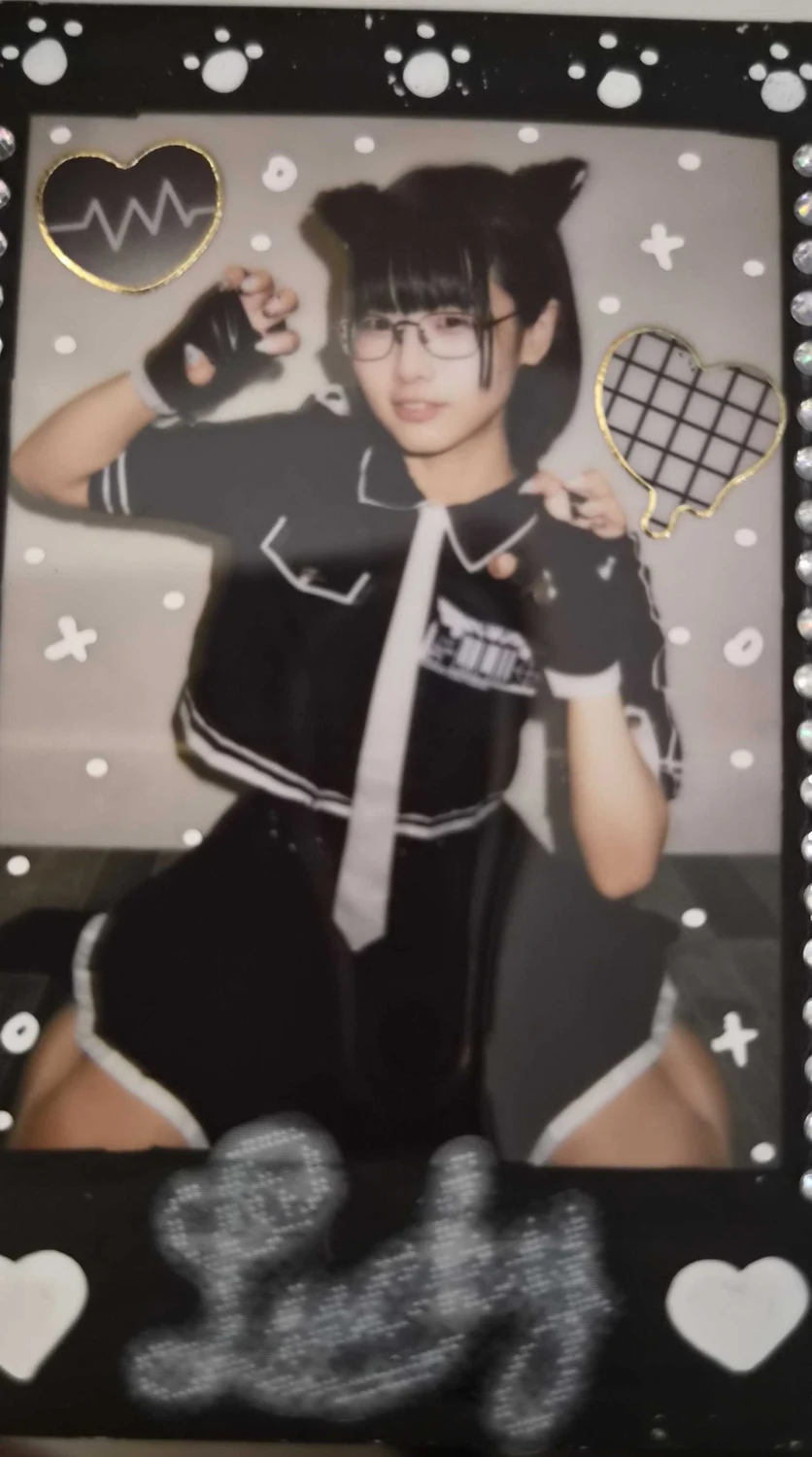
That is what I am holding when I hold that cheki. Not an image. Proof that, once, a person did something for me, knowing it was me.
So what is the magic, exactly?
Kanmi's homework cheki is the key to everything that follows, because it rules out the easy explanations.
The magic is not "physical versus digital." Plenty of precious things are digital. And it is not "met versus not met," because I never met Kanmi, and it is still one of my favourite things I own. The variable that actually matters is this: did a real person spend a piece of their life on the fact that I exist, one time, for me specifically?
That is the test. A real cheki passes it whether you are standing in Tokyo or sitting at home. Anything that passes it is a cheki in the way that counts. Anything that fails it is a picture. Hold that test in mind. Now look at what IdolChain sells.
What IdolChain actually sells
IdolChain runs a store selling what they call a "custom cheki." I looked at one: a thank-you image of kotty from PPPR!!-PIPOPARO-'s Germany tour, priced at 1500 yen (not much cheaper than a real cheki).
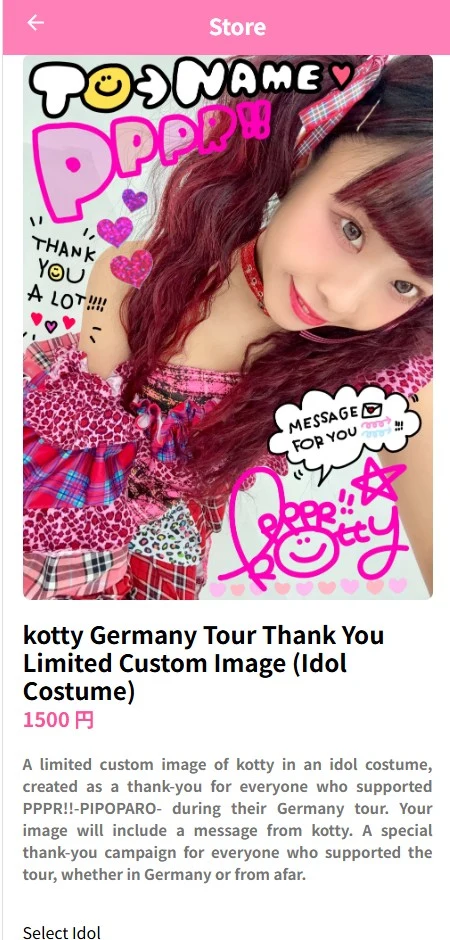
Here is what it is. A single decorated image, the same base photo for every buyer, with two things layered on top: a field that reads TO → NAME, where your name gets inserted, and a speech bubble that reads MESSAGE FOR YOU, where a message gets dropped in. The decoration, the hearts, the "THANK YOU A LOT," the layout, all of it was made once, by a designer, for everyone who buys.
Now apply the test. Did a real person sit down for the fact that I exist? No. The "MESSAGE FOR YOU" bubble was on the canvas before I existed to them. It is a design element, not a message: printed in advance, waiting for a variable. The arrow pointing at my name is not pointing at me. It is pointing at a field.
Put it next to Kanmi's homework cheki and the difference is total. Both were bought remotely. Both arrived without me ever being in the room. But Kanmi's has a person in it, the uneven marker, the squeezed-in name, the lopsided heart, the plan to actually look for my tweet. IdolChain's has a designer in it, and a fill-in field where the person should be. It has taken the exact parts of a cheki's intimacy, your name, a message, the member's face, a thank-you, and rebuilt them as fields in a template.
One eternalises a moment. The other manufactures the appearance of one.
Why the product misses
You could call this a clumsy one-off, a product that meant well and landed wrong. But look at why it lands wrong, and you find it isn't an accident of execution. It's the math of the thing.
The whole value of a cheki is that it was made once, for one person, and can't be made again. That is also exactly what a store cannot sell at scale. To sell ten thousand chekis, you have to remove the part that made each one matter and replace it with a fill-in field. The template isn't a mistake on the way to a better product; it is what you get when you try to mass-produce something whose entire worth was that it wasn't mass-produced.
You can see the same instinct in IdolChain's own writing. Their blog post "Selling to Overseas Fans Takes More Than Just Translation" lists three priorities for overseas sales: clarity, operational ease, and, in their words, design that leads to the next sale. It correctly spots the real problem, that overseas fans have fewer everyday touchpoints with a group, and then reaches for a smoother checkout instead of more touchpoints. I won't guess at anyone's intentions. I'll just say a checkout is what you build when the thing you're improving is the sale, and a cheki is what you make when the thing you're improving is the person.
The same framing runs back to the start. In a 2023 post, the founder described IdolChain as a blend of Japanese idols and NFTs, compared the work to poker, knowing when to go all-in, when to hold, when to fold, and likened himself to a surfer who had to already be in the water to catch the coming wave. Poker and waves are the vocabulary of someone describing a market to get in early. Read them next to a thing built to remember a moment between a fan and a person, and they sit strangely. I'll leave it there.
A note on the NFT question, because fairness matters
It would be easy to overreach here, so let me be precise.
When I first saw IdolChain, the name and the project’s NFT history made me assume the products might be blockchain-related. I asked them directly by email. They gave a clear denial: the goods were ordinary digital images and videos, not NFTs, with no wallet or blockchain knowledge required. I checked the store’s own product data, and on that evidence they were telling the truth. The cheki is served as a plain image file, with none of the markers of an on-chain token. This product is not an NFT, and the objection in this piece is not about cryptocurrency.
A later Twitter DM was slightly more qualified. IdolChain again said that the platform currently has no blockchain features and no present plans for NFTs, but added that blockchain-based features could be considered in the future if they created genuine value without encouraging speculation. The reply also said that “Chain” represents the connection between idols and fans, although the founder described IdolChain in 2023 as “a unique blend of Japanese Idols and NFTs” and wrote about using blockchain technology in the industry. Companies can change direction, but that history remains relevant. I am not claiming a hidden NFT. My objection is that the product treats the meaning of cheki as something digital templates and scalable features can reproduce, when its value comes from a personal act that cannot be mass-produced.
What blockchain would actually add
If IdolChain ever did add blockchain features, the likely value would not be greater personalization. It would be a way to attach verifiable ownership, artificial scarcity, and transferability to a digital image that can otherwise be copied without limit. The image itself would remain reproducible. What becomes unique is the token identifying one version as the owned or official collectible, which can then be numbered, transferred, or sold through a secondary market.
That may create a new commercial layer, but it does not solve the problem described in this article. A numbered token can make a digital product scarcer and easier to trade. It cannot make the idol spend time creating something specifically for the fan. Applied to IdolChain’s current model, blockchain would risk turning the same mass-produced template into a more financialized collectible, adding claims of ownership and resale value without restoring the personal act that gives a cheki its meaning.
The problem is not that technology can add nothing. It can authenticate a transaction, record ownership, and make a collectible transferable. The problem is that none of those things is what makes a cheki valuable in the first place. A cheki matters because the idol made this one for this fan. Blockchain can make a token scarce. It cannot make a mass-produced interaction personal.
What overseas fans actually want
None of this means digital products are worthless. A custom video, a behind-the-scenes clip, a digital bonus on top of real access: those can be lovely. The problem is offering them instead of access, as if a picture of the door were the same as opening it.
Because the barriers are real, and the answer to them is not a substitute. It is access. We know access can work across an ocean, because Kanmi's homework cheki already did. The real thing already reaches overseas. It just can't be packaged into a thousand-unit product, which is precisely why a company built to package things didn't build it.
So here is what overseas fans actually want, and it is not NFTs, not digital substitutes, not a smoother checkout. We want what Kanmi did. We want to be seen, once, by a real person who knows it is us. We don't want a special product invented for us. We want access to the real one everyone else already has.
A cheki eternalises a moment in time. IdolChain sells a file shaped like one. They will never be the same thing, and no amount of clever design closes the distance between a person who did something for you and a field with your name dropped into it.
